
How It Works
Molecular Filtration technology is based on polarity-driven interactions rather than conventional size-based separation. Our organophobic ceramic membranes are engineered to selectively reject non-polar organic molecules while allowing water and dissolved ions to permeate.
This mechanism enables effective separation of hydrocarbons, aromatic compounds (BTX), and complex organic mixtures from aqueous streams. By leveraging surface chemistry, our membranes achieve molecular-level selectivity in environments where traditional filtration systems are ineffective.
Conventional membranes filter by size. Molecular Filtration enables chemistry-driven filtration.
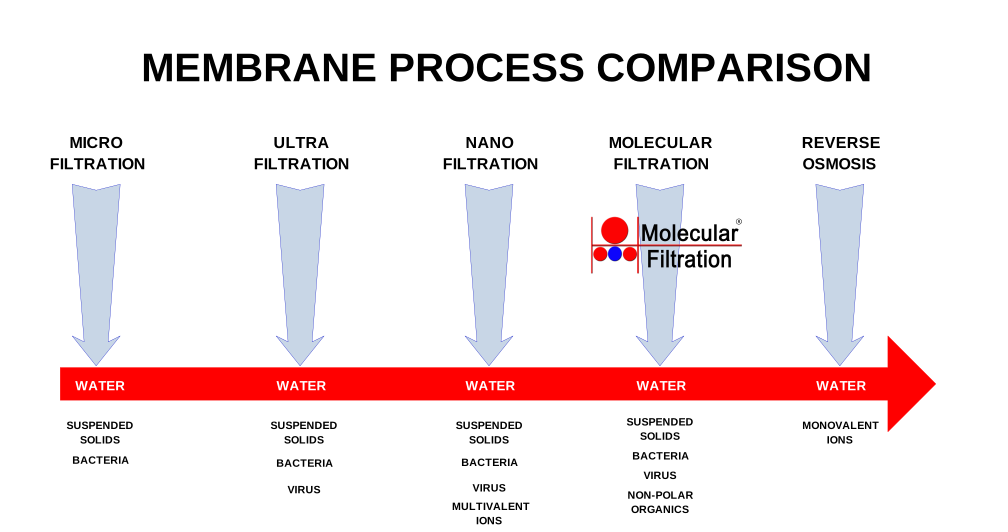
Process Comparison
Traditional membrane technologies rely on pore size to separate particles. Molecular Filtration technology extends beyond size-based separation by enabling selective rejection of non-polar organic compounds through surface chemistry.
Key Capabilities
Our technology platform delivers a unique combination of selectivity, durability, and process efficiency across demanding industrial applications.
- Selective rejection of non-polar organics: Designed for hydrocarbons, aromatic compounds, and complex organic mixtures
- Water and dissolved ions permeate: Enables chemistry-driven separation beyond conventional size-based filtration
- Stable performance in emulsions: Effective in challenging aqueous streams containing dispersed or dissolved organics
- Low-pressure operation: Typical operating conditions around 2 bar help reduce energy demand
- Ceramic durability: High resistance to temperature, chemicals, and mechanical stress
- Industrial integration: Suitable for modular, skid-mounted, and automation-ready process systems